
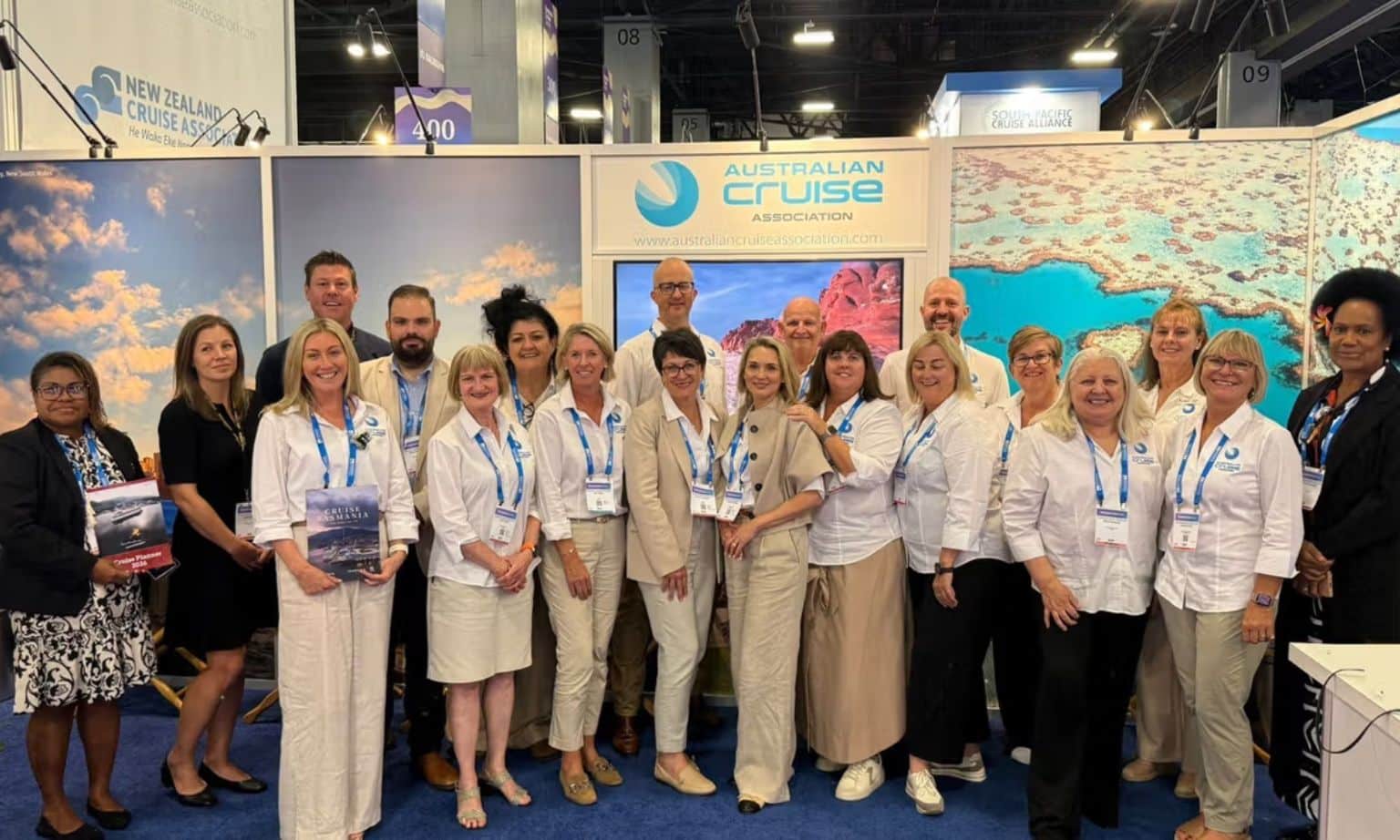
- NZ cruise fielded a government minister and 18 cruise representatives at the Seatrade Cruise Global conference in Miami last week.
- The result looks hopeful, with the NZ Tourism Minister claiming lines were reconsidering their decision to pull out.
- The 31-strong Aussie delegation lacked the same political firepower.
New Zealand has emerged as the winner after last week’s major Seatrade cruise conference in Miami.
A record 50-strong delegation went to the home of US cruise to convince line bosses to send us more ships. Australia and New Zealand are seeing record demand, yet fewer vessels sailing local waters. A market once worth over $8 billion for both countries has shrunk by as much as a billion.
New Zealand had 19 delegates, including a government minister. Australia’s delegation included senior Cruise Lines International Association Australasia, ports and tourism representations.
It was unclear if any Australian federal government officials were present. Though Cruisepassenger.com.au asked, no-one was willing to say.
The clearest sign of immediate progress at Seatrade Global came from the New Zealand side, where Tourism and Hospitality Minister Louise Upston said meetings had left her more optimistic about deployment for 2028/29.
Seatrade’s own reporting said a large New Zealand delegation of ports, destinations and suppliers, including Minister Upston, met with Cruise Lines International Association and individual cruise lines during the show.
After those meetings, Upston told Seatrade Cruise News she was “encouraged” that several lines were planning either to maintain their presence or return, and that she felt positive about deployments for 2028/29.
New Zealand has been particularly hard hit, with Australian cruise visitors falling 41 per cent in the last two years.
CLIA’s latest Australian source-market figures show a record 1.45 million Australians took an ocean cruise in 2025, up 9.5 per cent on 2024, yet CLIA says Australia is becoming less competitive as a destination because of regulatory uncertainty and rising costs.
CLIA and the Australian Cruise Association said cruise tourism delivered A$7.32 billion to the Australian economy in 2024/25 and supported more than 22,000 jobs, but that result was down 13.2 per cent on the previous year, which they said reflected Australia’s loss of cruise tourism to other countries.

For Australia, the post-Seatrade messaging was more about opportunity and advocacy than any announced deployment wins.
Destination NSW said Australia and New Zealand sent their largest-ever delegation to Seatrade this year, with representatives from Destination NSW, CLIA Australasia, the Australian Cruise Association and Port Authority of NSW attending the Miami event.
Destination NSW also said its regional manager in the US, Irene Morgan, met major cruise line representatives in one-on-one appointments and at networking events to promote NSW as a premier cruise destination.
ACA chief executive Jill Abel said in Destination NSW’s post-event release that there remained “a strong sense of optimism around Australia’s cruise future and the role our region can play in the next phase of global deployment.”
Abel said conversations in Miami continued to show Australia was recognised both as “a strong domestic cruise market” and as “a highly desirable destination for international visitors.” She added that with a strong orderbook of new ships over the next decade, Australia had “a clear opportunity” to play a bigger role in deployment patterns, particularly in the northern hemisphere winter.
That argument lines up with CLIA’s global message at Seatrade. The association said global cruise passenger volume hit a record 37.2 million in 2025 and that there will be 325 CLIA-member ocean-going ships in 2026, representing about 690,000 lower berths. CLIA president and chief executive Bud Darr said demand was at record levels and the industry was continuing to invest in new ships and destination partnerships.
The Australian and New Zealand delegations also used Miami to reinforce a united regional approach.
Seatrade reported that the Australian Cruise Association and the New Zealand Cruise Association renewed their memorandum of understanding at the event, with Minister Upston witnessing the signing.
The fate of the two markets is indivisible. New Zealand, with its beautiful fjord lands, is a key destination for lines like Norwegian Cruise Lines, Regent Seven Seas, Oceania Cruises, Royal Caribbean, Viking and others.
The agreement commits the two sides to continue collaborating on regional promotion, industry intelligence sharing and engagement with cruise lines.
Abel said destinations able to show “collaboration, consistency and a clear regional proposition” would be best placed to capture future growth, while NZCA chief executive Jacqui Lloyd said the deal would help both countries present “a united regional voice to industry partners.”
On the New Zealand side, officials were explicit that Miami was about convincing the industry the country had changed course.
Before Seatrade, Upston said the event would be “a valuable platform” to promote New Zealand, meet directly with cruise lines and show government support for the sector. After the show, Seatrade Cruise News reported that government and industry were aligned around reducing costs, cutting red tape and creating conditions for growth, after a 40 per cent drop in New Zealand cruise tourism in 2025/26 and flat deployment for 2026/27.
CLIA Australasia MD Joel Katz said in post-conference posts: “ This is the first time New Zealand has been represented at Seatrade at a ministerial level, and it matters.
“It sends a clear signal to global cruise lines that New Zealand is serious about rebuilding cruise deployment, with government and industry aligned around a shared goal: restoring confidence, improving competitiveness, and creating the conditions for long-term growth.
We had a constructive discussion about the practical steps being taken to provide the regulatory “certainty cruise lines need when making deployment decisions, because this is a highly competitive global environment, and confidence drives capacity.”
He cited French Polynesia as a success story with a coordinated approach over the past decade, growing from around 500 to 1,400 cruise calls, with a focus on smaller ships, community alignment, and high-value experiences. Cruise now accounts for around a quarter of their tourism economy.
That didn’t happen by chance. It’s the result of clear strategy and aligned execution.

Related Posts
-

The Cruise Lines International Association has released its annual environmental technologies and practices report, which provides updates on how the cruise industry is adopting more sustainable strategies.
-
‘Senior cruiser’ is a broad term for the over-55s that does not apply to everyone in the same way.
-
With China and the USA engaging in a well publicised trade war, we’re now seeing the effects bubble over into cruise.
-
There are three types of solo travellers: singles who want to mingle, introverts who prefer to keep to themselves, and those who are a bit of both.






The Federal Minister is not at all intetested in the cruise industry and has a green leftist agenda not in line with cruising. No wonder he never bothered to go to the US.