

Review: Azamara Journey

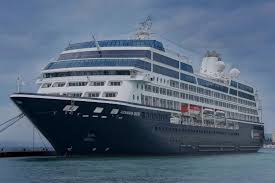
Table of Contents
It’s 7am local time and the jaunty Journey is heading for the volcanic island of Santorini, in the southern Aegean Sea. We left Piraeus at six o’clock last night after a seamless boarding process, during which we discovered we’d been upgraded to the top-of-the-range Club World Owner’s Suite – an amazingly spacious suite at the aft of the ship on Deck 8 that comes with the services of Sooria, our Indian ‘English’ butler.
Azamara Journey is a small ship – max pax 694, 30,277 tons – refurbed in 2007 in a traditional, ‘country house’ style with lots of wood panelling, antique-style furniture and, yes, tasteful carpeting. (Why do so many ships sport such garish floor coverings?) There’s an overall friendly, comfortable ambience to this ship – I particularly love the Drawing Room on Deck 10, an old-fashioned library with comfortable leather chairs. There are apparently 600 guests on board, many of them American and many surprisingly young, 30s to 50s on first impressions.
After sampling the thalassotherapy pool in the spa (a large whirlpool on Deck 9 exuding very powerful chlorine), cruise companion Melanie and I had dinner at Prime C, one of the ship’s two ‘signature’ dining rooms. Mmm, tuna sashimi and filet mignon … Going to have to hit that jogging track (or perhaps take a more conducive stretch class with the sculpted fitness trainer, a Kiwi called Joseph) before we drop anchor, to make up for the indulgence (before breakfast).
Early spring in Europe is proving to be a very cool affair. As soon as we boarded the tender to take us from the ship to the island this morning, I wished I’d taken my jacket with me.
No matter – the sun shone fitfully and the spectacular cable car ride to the township of Fira, perched on the cliff tops 270 metres above sea level, was enough of a distraction from the weather.
Cruise companion Melanie and I visited Santorini years ago and stayed at Oia, a picturesque village at the northern tip of the island, and couldn’t have imagined then that we would return, together, on a ship, or that I would be based in Sydney and she in London.
While the island’s tiny cobbled streets and whitewashed houses and churches looked much as we remembered them, the shops seemed to have multiplied beyond belief – how can so many shopkeepers selling the same type of jewellery, embroidered cushion covers and tourist trinkets all make a living?
We had a full day at Santorini and were thankful that when we arrived Azamara Journey was the only ship in the harbour; MSC Harmonia pulled in at 2pm and I imagine in the height of summer the number of tourists and cruise passengers pouring though Fira, the surrounding villages and vineyards would be quite overwhelming.
But no doubt they keep all those shopkeepers in business.
Back on the ship, we’re watching the news about the capture and death of Osama bin Laden. It seems a long way away from where we are, on a small ship in the Aegean Sea, where all we have to really think about is where to have dinner tonight.
Here’s Azamara Journey docked in her port of registry, Valletta, the capital city of Malta. This 16th-century city is a living history lesson and the guided walk we took around the streets and key sights was well worth the $41 charge.
We learned about the Knights of St John, how much of their wealth was derived from piracy and the constant battles for European power and position with the
Ottoman Empire. It took 10,000 workers four years to build Valletta and despite 3,000 air raids in World War II it remains one of the most historic areas in the world, and is a UNESCO World Heritage Site.
One of the many highlights was seeing the Caravaggio painting of the beheading of St John in St John’s Co-Cathedral. Following coffee in one of Valletta’s many charming cafes we took a taxi to the centre of the island, to visit Mdina, Ta’Qali and Mosta.
Mdina is a medieval walled city, and fascinating to speculate what life is like for its inhabitants today; Ta’Qali is a collection of nissen huts housing craftsmen such as glass-blowers (could have lived without seeing that, most of the work was pretty tacky); and Mosta is famous for its church, which features a 39.6m dome intended as a replica of the Pantheon in Rome. The church escaped destruction when it was bombed in World War II, as it failed to go off – you can see a replica in the sacristy, which was presided over by a slightly sinister man selling postcards and wearing dark glasses.
Onwards to Sicily – so much to absorb, so little time!
The ship anchored off Taormina at about 8 o’clock in the morning and we were treated to a spectacular view of Mt Etna’s snow-covered peak, towering over the island.
We had booked a day-long 4WD trip to the lava fields of the 10,800ft high volcano but as there were not enough takers it had been cancelled, so we set off for Taormina to see if we could find a local tour operator offering something similar.
I mentioned this to a beautiful Sicilian girl who was pointing people to the shuttle bus and she said her brother was taking a small group, would we like to join them if there was space? She called Francesco and as luck would have it there were two spare seats in his 4WD – within minutes he’d turned around and picked us up from the port. We joined a couple of American passengers from the ship, who’d booked the trip online, plus a Russian tourist, and for half the price of the ship’s tour we enjoyed a fascinating, educational day. Francesco was a superb guide, pointing out evidence of the country’s Greek, Roman, Norman, French and Spanish heritage.
At the foot of Mt Etna the landscape is lush, green and fertile – tropical plants grow in profusion alongside chestnut bushes
and cherry trees, and higher up the slopes you see vines, olive groves and citrus trees. Sicily is famous for its blood oranges and lemons (limoncello is on sale everywhere).
We stopped at St Alfio, a quiet, pretty village, to down espressos and buy lunch in a deliciously old-fashioned delicatessen and then proceeded up the winding road to the Chapel of Miracles. Built as a memorial to a village destroyed in an earlier volcanic eruption, a second lava flow in 1979 stopped, miraculously, at the chapel’s wall.
As we went higher thick clouds shrouded the dramatic craters and lunar landscape and silver birch trees loomed ghostlike through the mist. We walked along the edge of a crater, crunching over ash and cinders, clambered into a lava cave and stopped at the shortest road in Europe – one cut short by another massive lava flow.
As we drove back towards the port, we stopped at the medieval town of Castiglione and then walked down a series of steep steps to the Gole Cantara, a spectacular ravine where you can see more effects of Mt Etna’s eruptions in the form of columns of lava through which the river Cantara flows.
This glimpse of Sicily was more than enough to make me want to return – my father sailed around Sicily and Corsica in a small yacht many years ago and I hope to follow his course one of these days.
Meanwhile, we had a very special dinner on the ship to prepare for – Azamara Journey’s Best of the Best, hosted by Captain Jason Ikiadis, whose name is romantically Greek Odyssey although he hails from the totally English town of Southampton. Details to follow.
Best of the Best was a memorable dinner, hosted by Captain Ikiadis, cruise director Eric De Gray (very funny guy), hotel director Scott Daniels and chief engineer Evangelos Miskedakis.
It was served in the Drawing Room while we sailed through the Strait of Messina – Captain Ikiadis having left his bridge in charge of the local pilot. There were 12 guests and we were treated to five courses (OK foodies, they were: L’Oeuf Poule au Caviar; Marinated Blue Crab with Melon-Orange Dressing, Lobster Medallion and Herb-Phyllo Crisp; Peach Champagne Sorbet; Grilled Fillet of Grouper, Salad of Shaved Asparagus and Fennel, Yukon Gold and Sweet Potato Duo;) and some delicious wines.
The ship’s butlers were immaculate serving the courses and executive chef Lisa Anne Jones, whose expertise was much appreciated by everyone at the table, presented a superb chocolate surprise for pudding. Sadly no more room for the accompanying Chocolate Vodka-Tini – no wonder my clothes are becoming tighter by the day!
An interesting note from the souvenir menu: “Azamara is a coined term derived from the Romance languages. This includes the more obvious links to blue (az) and the sea (mar). The name was also inspired by a star, Acamar. In classical times the star Acamar was the most southerly bright star that could be seen from the latitude of Greece. We think of Azamara Club Cruises as a star on the blue sea.”
By 8am, Azamara Journey was anchored off the picturesque cliff-top town of Sorrento, where we have two full days to explore. Sorrento is 50 kilometres from Naples, 5 kilometres by sea from Capri and about 31 kilometres from Pompeii.
Our plan was to take the train from Sorrento to Pompeii but when we arrived at the station we discovered that there was a rail strike – these occur at random with little or no warning. Plan B was to take the local bus along the Amalfi Coast to Positano – but of course that was everyone else’s Plan B as well, so the queue was horrendous.
We waited, more or less patiently, and were eventually rewarded by a spectacular bus ride around the coastline to the former fishing village of Positano. Apparently by the middle of the 19th century more than half the population of Positano had emigrated, many to Australia, but it recovered and its popularity as a tourist destination began in the 1950s and has continued unabated ever since.
The town featured in the movies Under the Tuscan Sun and The Talented Mr Ripley and while its winding steps, tiny alleyways, flower-filled cafe windows and cute restaurants are incredibly photogenic, it is chock-a-block with tourists and difficult to get shots that don’t feature somebody’s back/head/hat.
We strolled down to the black-sand beach for lemon granita at a restaurant and decided to head for Capri by boat rather than re-track our bus route. A 50-minute, 50-euro (each) ride on a powerful rubber ducky on thankfully calm water took us past dramatic cliffs and three tiny islands (only one of which is inhabited) to Capri’s Marina Grande.
Naples was clearly visible across the bay – yet another destination to add to the To Do list of 10,000. The funicular railway took us up the rocky hill to La Piazzetta. This is the island’s main square and, like Positano, was thronged with tourists, so from there we took a local bus to Anacapri. As I tend to suffer from a fear of heights (which I’ve just learned is called acrophobia, not vertigo), taking the chairlift from Anacapri to the peak of the mountain was a challenge, to say the least.
It was an almost surreal experience, so quiet and peaceful, and the views, when I dared to look over the sea or down below to the rooftops and farmers’ gardens, were worth the panic. Here’s a photo of me at the top … A couple of stiff espressos back at a cafe in a peaceful sidestreet in Anacapri helped the recovery, and then we took a hydrofoil (15 euros) back to Sorrento in the early evening. I would like to see more of this beautiful, historic town than the port and Piazzo Tasso but tomorrow we make our second attempt to see Pompeii and, as on any cruise, it is simply impossible to do everything.
Attempt No. 2 to catch the train from Sorrento to Pompeii worked – a 30-minute journey that takes you right to the gates of arguably the most famous archeological site in the world.
Having had local guides at Valletta and Mt Etna, we knew we’d benefit from the services of an official guide here, and, after paying the entrance fee (11 euros), were lucky enough to find the wonderfully informative and entertaining guide pictured to the left, Mario Visconti (10 euros).
I took notes, photos, a map and guidebook but nothing can beat the experience of being there … and my brief blog can hardly do any justice to the centuries of history encapsulated in these 66 hectares of grand villas, houses, shops, restaurants, temples, public baths, marketplaces and amphitheatre.
Highlights from our two-hour-plus tour include: concerned comments from an English Azamara Journey passenger about the state of the stray dogs; another question from the same person about why Mario was smoking (“I organise my life Madam, you can organise yours”); the floor mosaic of the dog in the Poet’s House, underlined by the words Cave Canem (‘beware of the dog’); the Forum Baths; a brothel, its use made apparent by the phallic symbol on the outside wall; stepping stones across the streets so the citizens back in Roman times didn’t have to get their feet wet when it rained and all matter of rubbish flowed past; frescoes in a grand dining room; and information about how the “human excrescences” were disposed of.
There is a storeroom (former granary) where various amphorae and some plaster casts of victims of the eruption of Mt Vesuvius in 79AD are on display – I believe most of the preserved bodies are in museums around the world. It is humbling to realise that there are some 20 more hectares of the site still awaiting excavation, and that restoration and research is a constant process.
On the train back to Sorrento, I overheard a woman saying that the nearby archeological site Herculaneum, also destroyed and preserved in 79AD, was “much better” than Pompeii – yet another destination I have to add to That List.
This was the final destination on our history-packed Azamara Journey cruise – the end of the cruise being Civitavecchia, the port for Rome, located miles from the city – so we treated ourselves to one more dinner at Prime C for our last evening.
We were thoroughly spoilt on the ship, met several Azamara addicts who somehow manage to fit in several cruises every year on Journey or Quest, and saying farewell to the crew made me appreciate the whole experience all over again. Until next time.
First Time Cruisers Tips
Popular Destinations

Related Posts
-

Experience the unparalleled opulence of Azamara Journey, a luxurious boutique hotel at sea designed for refined travellers.
-
Azamara Cruises has unveiled its new 2027 cruises featuring 68 sailings including six Grand Voyages ranging from 35 to 41 nights.
-
Azamara's new Destination Immersion Elevated, where guests will get more opportunities to eat and explore like a local.
-
Regent, one of the world's leading luxury cruise lines, has unveiled "Iconic Explorations" offering guests a wider choice of free, multi-day land excursions on sailings in Europe and Alaska next…


Comments are closed.