

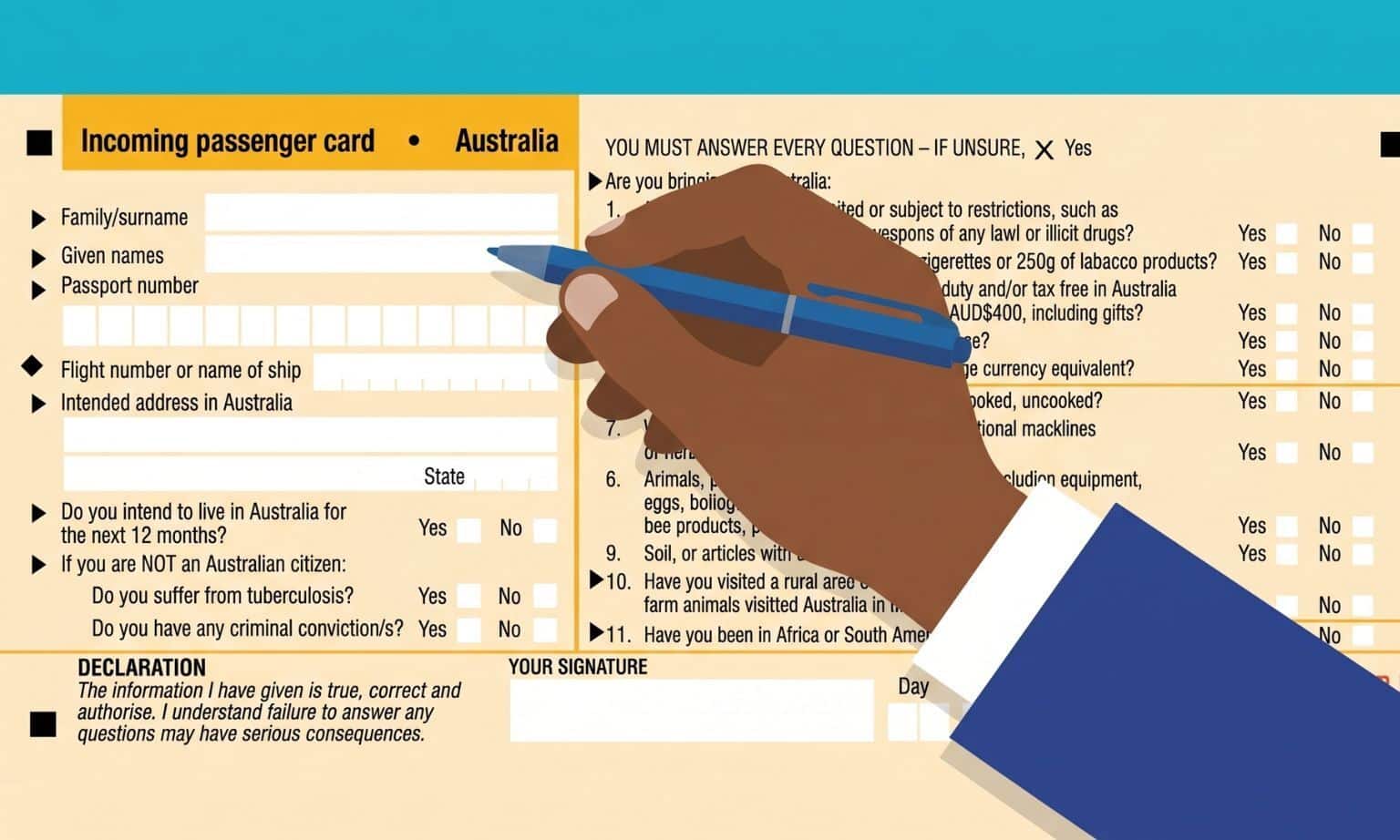
- Following a successful trial, the government has announced plans to roll out digital passenger cards across all Australian international airports and seaports.
- The nationwide rollout forms part of a $56.1 million push to modernise Australia’s borders.
- The digital system will be introduced over the next 12 to 18 months.
Australia will soon begin phasing out paper passenger cards in favour of a digital alternative, as part of a $56.1 million push to modernise the country’s border control system.
Gone are the days of awkwardly waiting to borrow a pen from your neighbour as the plane begins its descent. The pesky orange passenger card is set to be replaced by the digital Australia Travel Declaration, following a successful trial involving more than 450,000 passengers on eligible Qantas flights into Brisbane, Sydney and Melbourne.
The pilot will expand to Perth and Adelaide before the end of 2026, ahead of a phased rollout across all Australian international airports and seaports over the following 12 to 18 months.
Initially available using a web form, the digital declaration could eventually be integrated into an app, with the government planning to work with industry to further streamline the traveller experience.
With countries including Singapore, the UK, Japan and New Zealand already using digital arrival systems, Australia’s move away from paper cards marks a welcome step towards a more modern arrival process.
Minister for Trade and Tourism, Senator Don Farrell, stated, “Making arrivals simpler and quicker means visitors can spend less time filling out forms and more time enjoying everything Australia has to offer.”
“This is a win for tourists and a win for our tourism operators, helping make Australia an even easier and more welcoming place to visit.”
While the change promises to make arriving in Australia simpler, reducing manual processes for passengers, the government says the benefits will extend beyond the traveller experience.
The digital system is also expected to improve the quality of data used in risk assessments and allow border agencies to respond more quickly to emerging threats, including biosecurity outbreaks.
“The Australia Travel Declaration will strengthen Australia’s biosecurity by providing better quality information earlier, helping us identify and respond to potential biosecurity risks before they reach our shores,” stated Minister for Agriculture, Fisheries, and Forestry, Julie Collins MP.
“This investment ensures Australia’s border keeps pace with growing traveller numbers and emerging global biosecurity threats.”
A win for most travellers, but accessibility is key
Felicity Burke, APAC Director of FCM Travel’s Consulting business, welcomed the move, describing it as a practical win for travellers.
“It is a small piece of paperwork, but it has been one of the last bits of friction left in an otherwise fast, digital travel experience,” Burke said.
“Time is the real win here. Digital declarations get done before you land, which means faster movement through arrivals and shorter queues at immigration. For families starting a holiday or business travellers racing to a meeting, every minute counts.”
However, Burke said the success of the rollout would ultimately come down to accessibility, particularly for travellers who may not rely on smartphones.
“The real test is accessibility. Not every traveller is glued to an app. Families, older travellers and those without reliable data still need a simple option that works. Get that right, and this is a genuine win, not just a win on paper.”
The good news is that travellers who cannot access the web form will still be able to use existing paper forms. But for the majority of passengers, popping a pen in your carry-on luggage will no longer be necessary.
Find out more here.

Related Posts
-

The Scenic Eclipse II and a new Emerald Cruises yacht will offer itineraries around Asia, the South Pacific as well as Australia in 2028 and 2027.
-
Wondering which cruise line is the best for you? These are the best cruise lines in Australia according to our readers.
-
Australians will have to wait at least two to three years before a Windstar yacht will sail in local waters, says Helen Beck, Global Managing Director.
-
The Australian cruise industry has been urged to keep up the pressure to get the Australian government to help remmove the barriers that have meant fewer cruise ships this season.