
- The Maritime Union of Australia is running a campaign, alleging Carnival exploits its workers.
- Carnival has responded by saying it treats its workers in accordance with the International Maritime Organisation and International Labour Organisation Standards.
- So just how much do cruise ship workers really earn? It’s complicated...
The Maritime Union of Australia (MUA) has alleged that Carnival Cruise Line’s workers are being exploited. Carnival has responded and denied the claims.
Union Branch organiser Shane Reside told 7NEWS of Carnival Australia: “The company flies in seafarers from some of the poorest economies on Earth into Sydney or Brisbane.
“They join the ship, sail for a period anywhere between six months and 12 months ordinarily and then at the conclusion of their contract, they drive them back to the airport and fly them home.
“Now, while they’re here in Australia, working on Australian home-ported vessels, along the Australian coast, with predominantly Australian passengers on board, they’re getting paid wages commensurate with third-world economies.
“So it’s like they’re working in a hotel in Bali or Phuket, but floating along the Australian coast.” Reside also says they’ve heard of some working up to 300 hours per month.
The Union even posted a video showing passengers at OPT being questioned about how much they thoguht cruise crews were being paid. You can view it here.
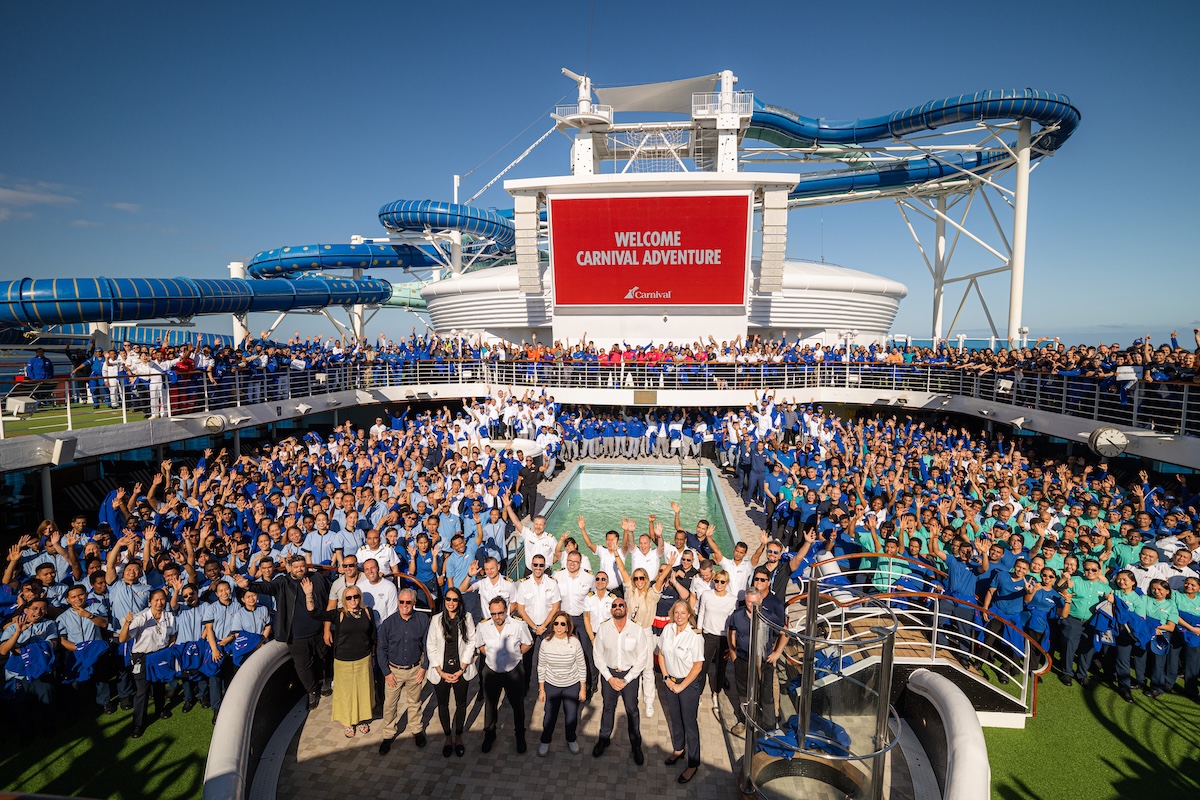
Carnival Cruise Line responded in a statement: “This is not reflective of Carnival which, in contrast, has a culture of respect with its thousands of shipboard team members from over 150 countries who have been with us for 10, 20, 30, even 40+ years and have built successful careers and been able to provide for their families through the partnership we have developed.
“Carnival shipboard wages meet and most often exceed International Maritime Organisation labour standards, and are supplemented by free housing, food, medical care, training, transportation and other benefits provided.
“We are proud of the fact that our retention rates lead the industry. In fact, more than 95 per cent of P&O Cruises Australia crew stayed on with CCL, when P&O folded into Carnival last March.”
For those who have never sailed with the crews of Australia’s home ported fleet, it must have sounded like the thousands of men and women working on board had been kidnapped into slave labour.
For those who have spent time with those crews and who have talked to them about their work and conditions, this might seem very confusing, as many cruise ship workers are openly happy with the opportunity to work onboard and are usually very open with guests.
Crews sign up for contracts time and again – some for all of their working lives. Like so many things consumers enjoy, from iPhones to cars, there is a global market for labour set, the shipping industry, by the IMO.
Why are crews paid less than national average wages?
Cruise Passenger has been down this road before. No cruise line will tell you how much they are paying their crews for commercial and sensitivity reasons, but after similar complaints we set about trying to build a model to test the effects of paying cruise close to Australian wages.
The results can be seen here. And while we acknowledge the calculations were thoroughly unscientific, it does demonstrate the knock-on effect for cruisers.
Let’s take a reality check: cruise ships are flagged (meaning based and governed by the laws of countries) all around the world. Complying with each country’s wage laws would be impossible.
Then there is the question of relativities.
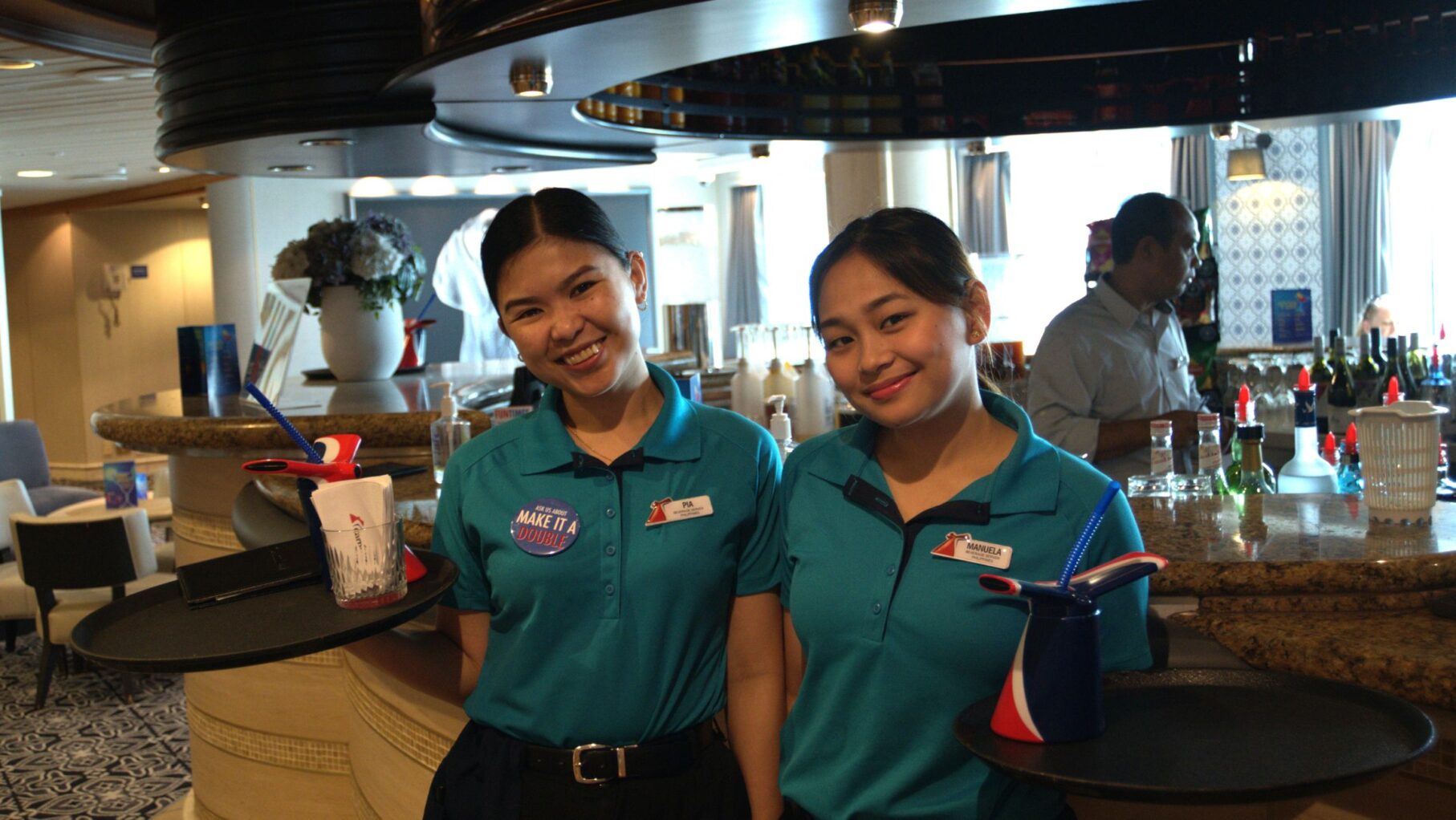
While a Filipino crew person’s wage is definitely low when compared to an Australian worker’s pay, it is good when compared to salaries back home. Uniquely, because they are housed and fed aboard the ships, they are sheltered from local prices.
For them, the question is simple: Am I better off than at home? And the answer is often: Yes.
For further context, Carnival Cruises is an extremely popular holiday choice for everyday Australians, with its low prices being a significant part of its appeal. Carnival has said more than 600,000 passengers per year sail on their cruises out of Australia.
Our low-ball estimates six years ago were that paying Australian Navy wages would raise the price of a cruise by around $400 a week per passenger.
The MUA has not made clear what its demands or suggested what would be for cruise ship workers in Australia. Their video simply asks cruise passengers how much they thought the crew was being paid and then, ina very strange take, ask if they know how much the president of Carnival Cruise Lines is paid.
Surprise! They got both wrong.
So how much do cruise workers earn?
It’s a question that is difficult to answer. Crews are sometimes hired directly from their home countries, and sometimes through agencies that specialise in labour hire and training staff in maritime hospitality. But, of course, the agencies take a cut of the crew man okr woman’s pay.
Carnival refers to the International Maritime Organisation, which works with the International Labour Organisation to regulate labour standards for crew members worldwide. These can be difficult to enforce legally, but they are expected to be followed by cruise lines.
In 2026, this minimum wage is USD$690 per month, which is AUD$1032. The ILO also dictates that crews work no more than 14 hours in a 24-hour period, and a maximum of 72 hours in a seven-day period.
Finding information on exact payment rates for different cruise lines can be difficult, but the general consensus is that most lines pay at least a bit more than the mandated minimum for lower level workers. Meaning salaries might look more USD$800 – USD$1200 in reality.
And luxury lines, because the training requirement is higher and tips are included, pay a lot more.
The MUA alleges that there are Carnival workers being paid as little as $2.50 per hour. If this claim is true and referring to Australian dollars, Carnival workers would need to be working 413 hours a month to reach the minimum wage, significantly more than is allowed by the ILO.
If Carnival meets the International Maritime Organisation labour standards, then this would mean workers are putting in a maximum of 308 hours a month for AUD$1032 a month, which is a minimum of $3.35 per hour. In theory, this salary could also apply for a 40-hour work week, which would equal $6.45 an hour.
This is well below Australia’s minimum wage of $24.95 per hour. But, as we’ve discussed, that isn’t the whole picture.
While cruise ship pay is often the focus of debate, so-called “perks” are what allow crew members to save nearly 100% of their earnings and do what really counts for them: send money home. It’s a huge cultural phenomenon and thousands of families and the education of siblings are supported by work on cruise ships.

What about perks
Most crew members receive these essentials for free on Carnival Australia ships:
Little or no living expenses: No rent, no utility bills (electricity/water), and no grocery costs.
Free Medical Care: Every ship has a medical centre. Crew members receive free consultations, medications, and emergency care while under contract.
Travel and Logistics: The cruise line typically pays for flights to the ship and back home at the end of a contract, plus any necessary hotel stays during transit.
Crew-Only Areas: These often include a private gym, a crew bar (with significantly cheaper alcohol than passenger bars), a crew mess (cafeteria), and often a crew-only pool or sun deck. Crew also get roughly 20–25% off at the onboard gift shops, spa services (during off-peak hours), and specialty dining.
What about conditions
While crew-only areas can be good and there have been many reports of below-decks parties and fun events, crews are are generallyk expected to be on call 24/7.
They also sleep in very tight living quarters, sometimes sharing bunks with other crew members when juniors.
Even under the law they can work more than 300 hours a month, and for workers in the engine room, they can work for long periods without seeing sunlight. While laws prescribe them allocated times of ‘rest’, they aren’t guaranteed any days off.
Conditions can definitely be tough.
Furthermore, while the perks can largely offset living costs, crew members can sometimes be asked to pay for Wi-Fi to contact their families, snacks, laundry and anything they wish to do in-port, if they want to take advantage of the destinations they visit.
Human Rights in Tourism mentions two specific cases where inspections were performed on cruise ships and exploitation was found.
One involved an MSC Cruise Ship in Brazil, which found 13 staff subjected to “slave-like working conditions”. The other was an inspection of Royal Caribbean’s Oasis of the Seas, which found staff who had been working up to 16 hours a day and others who didn’t have proper work permits. The cruise line was fined more than $1 million under Dutch labour laws and the International Maritime Convention.
Wage comparisons – are they fair?
Of course, minimum wages in countries like the Philippines and Indonesia, where many crew workers come from, are much lower than Australia’s.
In the Philippines, there is no national minimum hourly wage, with regional differences ranging from US$6.02 to USD$11.57, which means the monthly range, if working every day, is between USD$180.60 to USD$347.10 per month.
This is similar in Indonesia, where, depending on the region, minimums can range from about USD$136 to USD$340.
If Carnival is paying workers in accordance with the prescribed international standards, then workers generally have the chance to earn significantly more than the minimum wage in their own countries.
Which explains why cruise ship contracts are highly sought by workers from low-income countries, who can earn and save more than they might have the opportunity to do at home.
What about gratuities
This is always a touchy topic for cruisers: Do your tips really go to crew members is a really common question and leads many to use the old-fashioned technique of handing over an envelope of notes.
Some cruise lines simply build gratuities into their fare – particularly in Australia. Others asked passengers to make a donation, leaving a paper envelope in your suite or cabin. Either way, gratuities are supposed to go intoa common pool so everyone benefits.
While cruise lines generally don’t publicise this information themselves, some lines divide gratuities from cruisers will simply supplement lower salaries to ensure that the overall legal minimum is met.
This is because maritime law doesn’t dictate that a cruisers’ gratuities can’t contribute to their overall base salary.
This means rather than a worker earning a base salary of the USD$690 and then getting more tips on top of this, they could rather have a base salary of USD$400, receive their share of the overall gratuities, and that will bring their total salary up to USD$690.
It’s a thorny subject. But for many crew men and women, the tip at the end from grateful passengers can be an important part of the economics that makes working on cruise ships attractive.
What happens next
Since the Australian maritime unions haven’t spelled out any specific demands or issued any threats, probably not much.
But there is no doubt that cruisers feel a strong bond with their crews, and would not be happy if they were being exploited.
For the most part, this seems to be an economy within the cruise industry that works for everyone.
Tell us your stoires and what you think about how your favourite crews are treated in the commends below.

Related Posts
-

Carnival’s latest announcement of USA itineraries might not be of much interest to Aussie’s at first glance, but with a closer read, they reveal a few interesting points about Carnival’s…
-
On Carnival's Australian website, it states that "specialty coffees and teas" are excluded from the zero-proof package.
-
Aussie cruise bloggers Rob and Ali have started a petition for Carnival to keep it's themed cruises running in Australia, and it's already run up nearly 500 signatures in two…
-
Now it’s in its third life as a Carnival ship, it will continue serving up family-oriented vacations, sailing year-round of Sydney.