

Review: National Geographic Orion

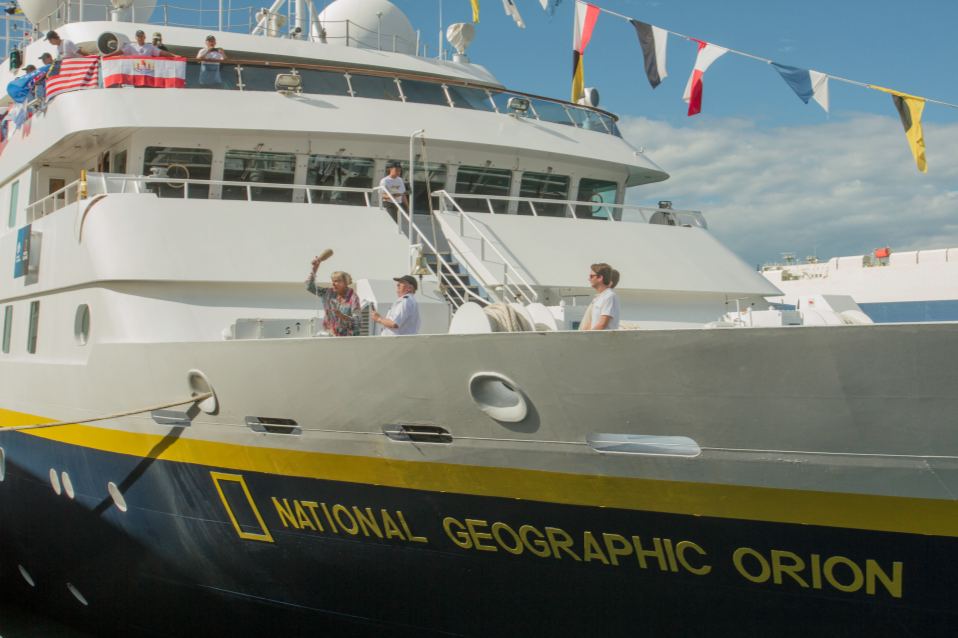
Table of Contents
It’s one of the most exciting moments in a ship’s history.
It marks the end of years of planning and the beginning of a new era, which all starts the moment that champagne bottle cracks on the ship’s bow.
Some lines celebrate a ship’s inauguration by inviting celebrities to perform for thousands of viewers. Others try to squeeze as many ship christenings as they can into one day.
But for us, yesterday’s ceremony was about ensuring our guests felt a part of the history making moment when Australia’s favourite adventure ship, the Orion officially became the National Geographic Orion.
Held at the Queens Wharf, Auckland, myself, the ship’s captain Mike Taylor, expedition leader Tim Soper and famous diver Valerie Taylor were on the bow of the ship, as our 102 first guests watched on the quayside.
Valerie announced the name of the ship and said ‘god bless her and all that sail in her’ before smashing the champagne bottle on the bow.
Seeing our guests breakout into a loud applause was a thrilling moment, which was made even more exciting when Glen, our on board musician, started playing the National Geographic theme music.
We then joined our guests for a toast, before embarking on the ship for her inaugural voyage to the Solomon Islands.
Bay of Islands: Day Two – At the crack-of-dawn on the second day of the National Geographic Orion’s inaugural sailing, she took her 102-guests and me into the Bay of Islands.
The water was calm as the sun slowly rose from the east to reveal a sheltered yet scenic bay off the small town of Russell and across the water I could see the historic site of Waitangi.
I joined everyone on board for a quick breakfast at the outdoor café, you must try fresh pastries that are made fresh daily – before heading to the ship’s Zodiacs.
Expert expedition staff on board and local guides took us on a historic water tour of the area.
Captain James Cook was the first European to visit this area in 1769. As well as naming the location Waitangi, he was also the first to interact with the local Maori people.
Whalers and sealers came next towards the end of the 18th century, and shortly afterwards the first Missionaries. But it wasn’t until 1840 that an official Treaty of Waitangi was signed between Europe and the Maori leaders to make this place what it is today.
Our guides gave us a full and rich rundown of this history, and what it means to Maori and Pakeha (New Zealanders of European descent) today, as well as an insight into the lives of the Maori, and their culture. Several large waka (canoes) were on display and made for spectacular photography.
I, along with other guests, wandered around the beautiful treaty grounds before watching a cultural performance and experienced a traditional welcoming onto the Marae.
Afterwards we were able to talk with and have photographs with the performers, before slowly walking back through the grounds on our own, or with the Photo Instructors or other Expedition Staff. They were able to point out flora of interest and some of the local wildlife, including tui, New Zealand fantail, variable and South Island oystercatchers and New Zealand dotterel.
We headed back to the National Geographic Orion for lunch in the sunshine, before boarding the Zodiacs again for time ashore in the quaint little town of Russell.
Once described as a ‘Hell-hole of the Pacific’, the town was renown for whalers and sealers. Today it is a picturesque town nestled amongst the forest covered hills, with bustling cafes and bars, small boutique shops, and tree lined narrow streets. We joined naturalists Tom, Mike, and Darrin for a walk to the top of Flagstaff Hill.
Other naturalists from the expedition team Brent and Richard led a nature walk spotting birds and enjoying the rich flora. National Geographic Photographers Amy and Matt led a photographic walk around the town. With sunshine and warm temperatures, it was not hard to enjoy our time ashore, but before long it was time to head back to the ship.
As the anchor was raised, the last of the Zodiacs were hoisted onboard, and we sailed out of the Bay of Islands to be greeted by a pod of bottlenose dolphins.
The animals ‘played’ with the ship, riding the bow wave created by the bulbous bow, and we had great views of these large dolphins from the front of the ship. They escorted us for a little while, as we headed northwards along the eastern coast of Northland.
Norfolk Island: Day Four – There’s one thing you’re guaranteed to see on a National Geographic Orion expedition – nature at its best.
And that’s exactly what we were treated to on day four of the vessel’s inaugural voyage, when a mass of birds welcomed us into Norfolk Island.
Masked boobies, white terns, black noddies, red-tailed tropic birds, wedge-tailed shearwaters, black-winged petrels, and others escorted us the last distance to the anchorage site off the southern harbor known as Kingston.
At Sea: Day Five – Expeditions are about exploring, meeting new people… and food.
Let’s face it, if you’ve been out in the Zodiacs looking for that wildlife moneyshot, you’ve earned a well-cooked meal.
Serving food on an expedition ship is a culinary artform in itself. Did you know Australia’s renowned international chef, Serge Dansereau created National Geographic Orion’s degustation menu?
He’s been behind the wonderful food we serve for the past 10 years.
Executive chef Lothar Greiner who has also worked with the well-known chef to create on board meals, told me the ship has embraced Serge’s French techniques and use of local produce.
“As the onboard Executive Chef, I share the same love of Classical French Cuisine with Serge and have embraced his philosophies over many years and our highly trained dedicated Chefs are able to reproduce selected menus here onboard the National Geographic Orion,” he said.
“All of the other onboard menus are created by myself and lend themselves to a similar food philosophy.
“I am able to create further options and variety on our menus and use produce from the local market places in all of our destinations.”
Lothar says ingredients are sourced from New Zealand, Australia, South East Asia and the South Pacific.
So as National Geographic Orion sailed from Norfolk Island to Tanna Island in Vanuatu, I decided to use my sea day to concentrate on one thing – eat.
Greeted by my waiter I settled on a three-course meal.
For my entrée I ordered the grilled kingfish topped with sweet crisp sweet corn, pickled rice wine vinegar – wakame, delicious ricotta and chicken tapioca.
It was cooked to perfection.
Next up was my main – a roast beef fillet with grilled asparagus and confit potato, black garlic, parmesan and picked onion shells.
But then it was time for the most important meal of any sitting – dessert.
I’d selected the chocolate pave with chai mousse, white chocolate jelly, hazelnut soil and chocolate ice cream.
It was chocolate overload and I was loving it! It was a part for my senses and I recommend anyone on National Geographic Orion try the chocolate pave.
By the end of the day, I felt like I may have gained a couple of kilos, but it didn’t stop me from joining other guests in the Leda Lounge for a glass of chilled champagne.
Tomorrow, I will be sure to join the walks awaiting at Vanuatu.
Ifira Island and Lelepa Island: Day Seven – Have you ever wanted to go diving with ocean legend Valerie Taylor?
I did.
Today was a special day for guests and staff on board the ship.
or months we’d been planning and preparing to send guests diving for the first time aboard National Geographic Orion.
Without local knowledge, our Dive Masters Ian and Justin used charts, their experience and gut feelings to take guests, including myself on a dive on the north side of Ifira Island.
Everyone was in awe and of course, snapping pictures. It was a magical way to start the day.
As the flock flew away, guests switched off their cameras for a hearty yet healthy breakfast of tropical fruit, yogurt and delicious freshly made omelets before boarding the Zodiacs for a tour of the islands that is also an ancient volcano – Kingston.
With near perfect conditions, we had a chance to visit the ruins of the stone buildings which housed the prisoners.
Norfolk Island was founded in 1774 by Captain Cook. At the time of discovery he described it as dense forests of Norfolk Island pines and surmised the trees, which would be ideal for use as ships’ masts and spars, as well as lumber.
A few years later, a small colony was established here to process the ‘pines’ and grow flax for the production of cordage and fiber. The first colonizers were prisoners who built the notorious penal colony at Kingston Harbour and began harvesting the Norfolk pines.
However, the trees soon proved unsuitable for ship supplies as the wood is too flexible and brittle for use as masts and not nearly as good as other woods for plank and deck works.
Throughout the 18th and 19th century it was used as a prison, before it was given to the growing population of Pitcairn Islanders.
Today, it houses nearly 2,300 people.
As part of our shore excursion, locals told us stories of the inhumane treatment of the convicts before the prison was shut down in 1855. They are also gave us a tour of the island and half of the group, including myself, went on a long hike on the nature trail in the Norfolk National Park.
Another example of nature at its best, the hike took us through a dense forest composed of Norfolk Island pines, of course, as well as endemic tree ferns (the world’s tallest), endemic palms, Ti trees (also known as cabbage trees), and many other species of trees and shrubs, and then coursed along the coastline for views of steep embankments, cliffs, and offshore islands.
Most of the endemic land birds were sighted by keen birdwatchers during the hike.
Returning to the Zodiacs after the hike, we reboarded the ship for dinner created by one of Australia’s renowned international chefs, Serge Dansereau.
After dinner, the majority of us headed to National Geographic Orion’s Leda Lounge. It’s one of the prime spots on board toe meet fellow cruisers and enjoy an ice cold beer.
As we sailed away, the captain took a turn around Phillip Island a short distance off the south end of Norfolk Island, so we could enjoy more beautiful scenery and be entertained by flocks of masked boobies diving for fish before heading northward for Vanuatu…our destination in two days.
Day Eight – Pentecost Island, Vanuatu: There are some things on this planet you just have to see to believe and the land divers of Pentecost Island are definitely one of them.
It doesn’t matter that it was mentioned in the itinerary you poured over before boarding the National Geographic Orion, or announced in the daily intentions. You won’t truly appreciate it until you’ve witnessed it.
It was now day eight on the ship’s inaugural voyage as we made our way to Pentecost in Vanuatu.
We had an early breakfast before boarding the Zodiacs to shore.
Once on land, we followed a path up the hill to get our first glimpse of the 70-foot tower, made only of wood and vines.
The singing started as we got closer and the young boys and men began to climb.
They jumped off various parts of the structure that stands well over ten times their own height.
Known as ‘divers’ they climb up thin platforms that will barely support their weight. The platforms eventually snap as they jump from these heights and it helps to break their fall once they take the ultimate in leaps of faith.
Lashed to their ankles are vines that have been expertly measured and tied by veterans of this extreme ritual that is only practiced here on this one island of Vanuatu.
I couldn’t help but hold my breath and they went higher and higher because eventually they were going to jump.
And they did.
They jumped off various parts of the structure that stands well over ten times their own height. A structure that was built just a few weeks ago and is devoid of even a single nail, screw or any other scrap of metal.
There were 15 divers, each took turns, and each jumping higher than the next.
The youngest, and first to take the plunge, was only six years old and he plunged from twenty feet above the ground.
As they continued jumping, the song becomes a chant, and it draws down to the last diver.
He ceremonially raises his hands high above him and begins to almost imperceptibly rock back and forth.
Time itself seems to pause and become another member of the audience, utterly captivated by the anticipation of the moment.
Then, as if it was the most natural thing to do in the world, he leans forward and drops, falling towards the earth below, and into our memories forever.
I still can’t believe it though.
Day 9 – Espirito Santo: It was now the ninth day on National Geographic Orion’s inaugural voyage and we continued to make our way through the South Pacific.
Many of us, including myself were still talking about the land divers we watched take the plunge yesterday.
But after a quick breakfast, we were ready to explore Vanuatu’s largest island, Espirito Santo.
We boarded the Zodiacs and headed to shore.
Jungle clad slopes, bird watch, white sandy beaches, sheltered waters, and a huge World War II history – there was so much to do on the island that we had to split into different groups.
Some went bird watching while others enjoyed a canoe ride and refreshing swim in a crystal clear pool.
I decided to go on my second dive to see the wreck of the SS President Coolidge.
“Carefully, we weaved our way through assorted passages
and reemerge onto what was the side of the vessel.”
Originally built as a luxury liner, the “Coolidge” was converted during the war to a troop transport. The ship was approaching the town of Luganville on Espirito Santo when it struck a mine, and was run ashore by the captain.
Now, many years later, it is lying on its side, just a short distance offshore, making it one of the great dives in the South Pacific.
Once in our diving gear, we walked into the water from the jungle and descended to about sixty feet.
The bow of the vessel was the first part of the ship we could see. As a result of being underwater for so long, it is slowly breaking apart and being taken over by coral and various invertebrates.
Working along one side of the vessel, we passed an impressive bow gun, and even entered the ship into one of the cargo holds.
We could see various relics strewn throughout, including howitzers, jeeps, and tracked vehicles.
Carefully, we weaved our way through assorted passages and reemerge onto what was the side of the vessel and now is the top.
Unfortunately, our air supply was starting to run low, signalling it was time to return to shore, so we started making our way back.
After the dive, the group of us took a moment to reflect not only on what an incredible dive it was, but also onto just what a marvelous destination Vanuatu is.
Day Ten – Lo – “National Geographic Orion is different from other expedition ships because it’s also quite luxurious.”
As the ship continued its inaugural voyage, I took the morning to chat to the woman in charge of accommodation and cabin satisfaction, Tracy Greiner.
Tracy says the ship still retains luxury features, including five-star cuisine; an outdoor whirlpool hot tub; eco-sensitive bathroom amenities; mini refrigerators; a glass elevator; sauna; and luxury spa service.
As part of recent renovations, the ship received a new glass bottom and dive facility, which she said has been a major hit amongst cruisers on the inaugural voyage because it gives guests a unique view of the ocean.
And I’d have to agree.
She told me recent renovations also included room enhancements and further adventure sources for guests.
“There’s a high quality Atlas for personal use in each cabin,” she said.
“There’s also a larger expedition team and world class speakers.”
Before heading off to start her shift for the day, she said she has love for Lindblad because her job allows her to create memorable experiences for guests and for crew.
It was also time for me to make the most of our last day in Vanuatu.
Our destination for the day the tiny island of Lo in the Torres group, an island which only rarely receives visitors. The Zodiac landing was a small cove with the softest white sand beach, fringed by coconut palms beneath a tropical blue sky. Behind which was a small village which had made extensive preparations for our arrival.
The first event of the day was a chance to attend the village church service, which provided a fine opportunity to see another side of life in Vanuatu.
Then the music and dancing began in earnest, first from the Lo Islanders and then a special performance by a group of musicians from the nearby island of Gaua. These women have developed a unique style of water music, standing waste deep in the ocean and using their hands, mouths to create an amazing percussive performance.
The entire village turned out to see the performance, clearly as excited as we were by the opportunity.
After our morning ashore we moved on towards our next stop and a new country – Santa Ana in the Solomon Islands. At some levels it seems unimportant that one group of islands is in Vanuatu and another in the Solomon Islands. It would be easy to believe that these people know or care little of nothing of life in Port Vila or Honiara. Whatever their nationality, it is a pleasure to travel and meet these open and friendly people.
Day 11: Solomon Islands – It was a sombre morning for everyone on board, as this would be our last full day on board.
We were all keen to absorb as much as possible before we headed back to reality.
We enjoyed a relaxing morning at sea, watching flying fish, various sea birds, and some marine mammals (including false killer whales and bottlenose dolphins) as National Geographic Orion entered the waters of the Solomon Islands.
The port-of-call today was the island of Santa Ana – a small, raised coralline island located at the southeastern end of the archipelago.
It contains three villages and has a total population of 3,000 people.
We hopped off the Zodiacs and onto the white sand beach. Angry warriors erupted out of the surrounding trees carrying spears and lethal-looking slashing clubs, threatening us all with instant death.
This is the island’s traditional welcome to show esteemed guests that the indigenous people could destroy us if they want to. Thankfully, they chose not to.
After we were greeted by the various chiefs and big men, we all walked through the beautiful, tree-shaded village to a large field for what was nothing less than an extravaganza of music and dance.
The musical performance was quite different from anything we had thus encountered and included a very accomplished band of pan pipers, as well as a master of the famous Solomon Island bamboo piano.
The costumes and body painting exhibited in the dances were also impressive and were all the more photogenic by having the dancers perform in an open field.
The first few traditional dances were designed for large feasts both in honour of high chiefs and as provocative wedding gatherings, but the highlight was a dramatic reenactment dance known as the Aimatawa-Aifonofono. This recounted an ancient event, when Polynesian warriors came to the island and tried to steal some of their women and children. However, the mighty Melanesian warriors saved the day and drove them off.
The crowd of local children got so worked up over this performance they poured onto the field to help drive away the Polynesians.
Everyone got caught up in the moment, even us.
A little later in the afternoon, many people opted to go snorkelling at the reef edge bordering the entrance to the main lagoon.
I decided to walk to the far side of the island to visit one of the other villages and have a look at two sacred spirit houses where chiefs from long ago are interred.
It was an energetic hike to get there, on a good coralline track that took us over the central plateau, and gave us a chance to enjoy much more of this appealing, lush island.
The far village, located on the windward shore, turned out to be even more traditional in the sense that there were no corrugated iron roofs or concrete pillars in evidence, and obviously much less affluent and prosperous than the village where we originally landed. However, it is even more photogenic, if that is possible.
Everyone returned to the ship by sunset and we steamed out of the lagoon with a cocktail party on the upper deck.
It was our last night on board, so needless to say we made the most of it with several on board cocktail specialties and beers.
Day 12: Honaira, Solomon Islands – Reaching the final destination is bitter sweet.
Part of you can’t wait to return home and share all your new tales. The other half really doesn’t want to say goodbye to the ship, the people and the holiday.
But as we arrived in Honiara in the Solomon Islands we all suppressed the sombre side.
The beautiful sounds from a flute band greeted our ears as we made our way alongside Port Cruz Wharf in Honiara.
It was to be a very busy day with lots on offer including World War II tours and various village tours. Sadly some of us were disembarking the ship to join onward flights home.
Historically Honiara has a somewhat sombre past with various wars that have heavily impacted on its people and its landscape.
The Guadalcanal Campaign in 1942 between the United States and the Japanese brought fierce battles to the shores of Guadalcanal.
Most of these battles took place at Henderson airfield which is now home to the Honiara International Airport.
Those flying home today reflected on the airport’s peaceful surrounds that now hide the airstrip’s murky past.
The World War II theme was increasingly evident with some of us visiting the American War memorial at Skyline Ridge.
The memorial sits high, proudly overlooking the now peaceful city of Honiara. For many of us it was a time to reflect on the many men and women who lost their lives fighting for the freedom we now often take for granted.
This afternoon the National Geographic Orion cruised into Rodrick Bay to see traditional life in the Solomon Islands.
Dolphins, flying fish, and fisherman in dugout canoes provided great subjects for photography along the way.
It was finally time to head home.
First Time Cruisers Tips
Popular Destinations

Related Posts
-

For $568,400 per person you can live a life of luxury in a two-bedroom Owner’s Suite on a World Cruise for 149 days onboard Silver Dawn.
-
Virgin Voyages has offered a brand new annual pass - a pass that offers a year of unlimited access to all ships and itineraries
-
Starting from around $465,000 this experience involves cruises across four different cruise lines and two luxury rail rides
-
Cruise lines have threatened to sue the Hawaiian government for introducing new taxes based on a per cabin or per person fee.


Hi Jeremy,
Congratulations on the inauguration of the National Geographic Orion and the start of your first voyage. I know everyone has worked incredibly hard to get to this point so it makes the moment even sweeter. Have a wonderful voyage and remember us poor land lubbers stuck back on shore.
regards to all,
Tony