


- Laura* and her family spent $13,000 on a Carnival cruise and travel costs to the South Pacific.
- They were informed the night before that the cruise wouldn’t go to the South Pacific due to adverse weather conditions.
- Laura felt this was a big enough change to the itinerary that she was entitled to a refund. Now she has launched a legal challenge, which if successful, could inspire other cruisers to do the same.
Everyone knows that cruising is weather-dependent. It’s all too familiar for cruisers to find out that a port has to be changed due to bad weather, and while it’s a shame, cruisers are often compensated with a lot of onboard credit.
However, what about when your cruise is changed entirely? When you’ve saved up, taken time off work and booked a cruise that works for your availability, only to be told that you’ll now be visiting a completely different destination?
This is what happened to Laura McCarthy, her husband, their four kids and their parents. And now she is challenging the cruise lines’ terms and conditions because the change meant the cruise was no longer what she bought and paid for.
It will be a closely watched case, as most cruise lines use terms and conditions when changing itineraries as their defence against compensation claims.
Laura told Cruise Passenger: “We had a cruise booked for the Pacific Islands. And we’re from Melbourne, so we travelled to Sydney on the 15th of January. Mum likes to get there the day before when we’re going on a cruise.
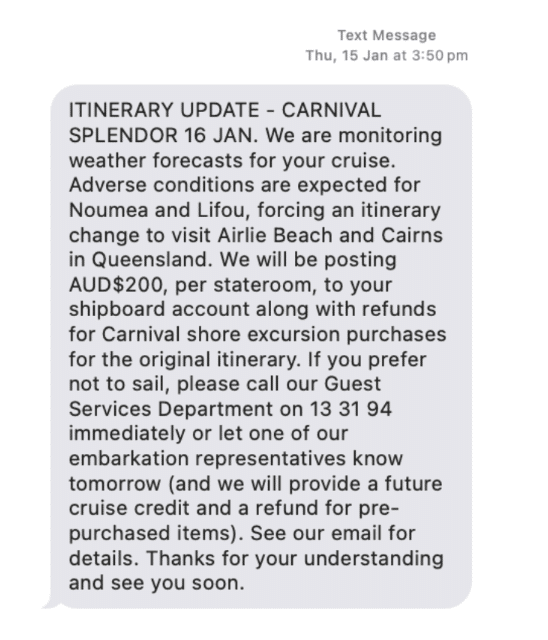
“We checked into the hotel at about four o’clock, then the night before our cruise, we get a text message from Carnival to say adverse conditions are expected for Noumea and Lifou, forcing an itinerary change to visit Airlie Beach and Cairns in Queensland.
“So we rang them up, we were on the phone for about two-and-a-half hours, and we told them, we’re not paying $13,000 to go on a domestic cruise. They just kept insisting that, due to the terms and conditions, that our two options were to take the Queensland cruise or to take a future cruise credit. We kept insisting that wasn’t acceptable. We were trying to use ChatGPT in the middle of it to see what our rights actually were.
“And you know, it was a major change to the itinerary. It went from being an international cruise to a domestic cruise. It was just going around in circles; they kept insisting they didn’t have to give us a refund.”
Laura and her family decided not to get on the altered cruise, leaving them $13,000 out of pocket, and unsure of when they’d be able to coordinate the whole family to be able to travel together again. She said in a Facebook group for the cruise there were plenty of other upset passengers; some had even purchased passports especially for the trip.
Laura isn’t suggesting that she wanted her ship to sail into bad weather, but rather that the service she purchased was no longer able to be offered, and she believes she is entitled to a refund.
She has now launched a case with the Victorian Civil and Administrative Tribunal, which promises to be something of a test case for the cruise industry.
Laura was offered a future cruise credit or to sail with $200 onboard credit per stateroom, but she and her family did not believe the new cruise was the same holiday that they booked, and didn’t know when she’d be able to coordinate her family to travel altogether again on another South Pacific cruise.
It should be noted that this issue is not exclusive to Carnival, all cruise lines maintain the same terms and conditions. However, consumer advocates and industry lawyers are questioning if the current legal structure for these situations is sufficient for Australians.
“We need the laws in place to protect Australians such as Laura”

Adam Glezer, owner of Consumer Champion, a consumer advocate agency who helps customers in the travel industry understand their rights and seek compensation where necessary, says there needs to be tighter protections in place to protect customers like Laura.
His view is that the sailing being moved to an entirely different country is a significant enough change that cruisers should be entitled to refunds in this scenario.
“This is a major change — full stop. If a trip like this isn’t refundable, how can any Australian book a holiday with confidence? Right now, they simply can’t.”
Glezer says that Australian Consumer Law is often vague and left up to interpretation, leaving everyday Aussies vulnerable.
“There are clear gaps in the law that need to be fixed. It’s not good enough to leave things open to interpretation — the law needs to spell out exactly when a customer is entitled to a refund. No grey areas, no loopholes.”
“A line has to be drawn here. They were being told, before the cruise even left port, that they won’t be visiting a single overseas destination they paid for — which was the point of the trip for Sinead and her family. That is not acceptable.”
“Lawmakers have got this badly wrong. Every day Australians are being left completely exposed while corporations do as they please — and that has to stop.”
Glezer says it’s essentially a matter of common sense: why should holidaymakers have to accept going on a trip that’s completely different to what they paid for?
“The decision makers at Carnival should ask themselves — does this pass the pub test? If it was your mum, your dad, or your mate who’d saved up for months for a dream holiday and was told they wouldn’t get their money back, would you accept that? Nobody would.”
“These are ordinary everyday Australians who work hard, save hard, and don’t have thousands of dollars sitting around to fight a corporation in court. The cruise companies know that and take advantage of it. Australians deserve better.”
“These corporations have deep pockets and armies of lawyers. Every day Australians have neither. The law is the only thing standing between them — and right now, it’s failing.”
Why the terms and conditions shouldn’t stop you from seeking compensation
Every cruise line in the world will mention that they may make changes to your itinerary at their own discretion.
Victoria Roy, the principal solicitor at Victory Travel & Cruise Lawyers explains that these terms and conditions are not necessarily binding. However, the tricky part is that due to the vagueness of the law, these cases have to be evaluated on a case-to-case basis.
Roy explains that there has been a case in the past, Moore v Scenic Tours, where Scenic was unable to rely on the terms and conditions they had presented and was found to have breached the ACL.
Roy explains that there are currently no specific rules for determining if a case will be successful or not.
“Cases are decided on a case-by-case basis and are usually very fact-specific. It is therefore hard to come up with any hard and fast rules to help your readers. However, I would say that one factor that would be crucial for a claim to be successful is that the itinerary change had a significant impact on the cruise.
“That of course will depend on the itinerary and what changes were made. Under the Australian Consumer Law (ACL), a cruise line guarantees to provide services that are fit for purpose and are of a nature and quality that might reasonably be expected to achieve the result desired by the passengers.
“No doubt as well as enjoying the cruise experience, passengers were expecting warm weather and foreign destinations in the South Pacific rather than a domestic cruise.”
However, Roy says, despite a clause that cruise lines may rely on in the event of weather conditions or other events outside their control, if the cruise line knew about the changes in advance, passengers should still consider seeking compensation.
“The infamous s.261(1)(c) ACL exclusion that we all know about from COVID applies to breaches of ACL guarantee: where the breach was due to an act by a third party or a cause independent of human control after services were supplied.
“I would say that if a passenger experienced significant itinerary changes that were within the cruise line’s control, or which the cruise line knew about or ought to have known about in advance, the passenger should not be deterred by the Ts&Cs and still seek compensation from the cruise line.”
*Laura’s real name has been changed to protect her privacy

Related Posts
-

Aussie cruisers heading out to the South Pacific have received a stern warning from Carnival to use swimwear that isn't offensive to the locals of these islands.
-
Experience an unforgettable Asia Pacific expedition cruise with Swan Hellenic. Explore remote islands, vibrant cultures and untouched wilderness in luxury and comfort.
-
A massive 8.8 magnitude earthquake near Russia has led to the issuing of tsunami warnings across the Pacific. A range of cruise ships could be affected, with warnings issued across…
-
Cruise Passenger readers always have plenty to say about what’s going on in Australian cruise, and in the broader cruise community.