

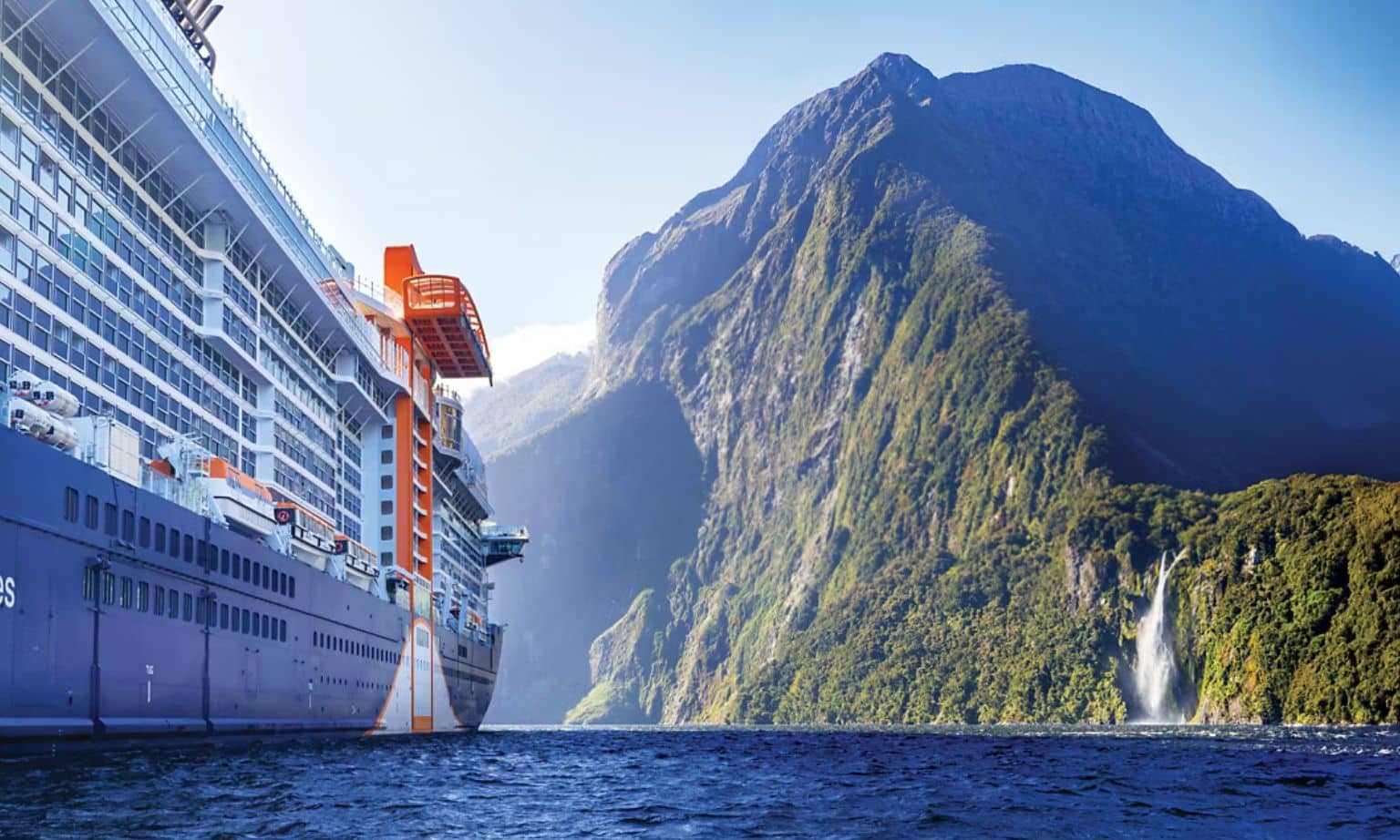
- New Zealand has released details of its strategic cruise plan and its goals for 2040.
- At the same time, key industry voices continue to express concern at how Australia desperately needs a similar level of industry and government collaboration, but isn’t getting it.
- While New Zealand’s cruise trajectory is looking positive, but question marks hang over Australia.
New Zealand continues to steam ahead with its collaborative cruise strategy, formed by industry and government together and presented by the New Zealand Cruise Association.
With the plan already delivering impressive results since rolling last year, a new phase is coming, with goals set directly for 2040, and what the local industry hopes to achieve over the next 14 years.
Since the plan was put into action, with careful thought put into it by engaged politicians and industry representatives alike, it has delivered plenty of quick wins for New Zealand cruise. For example, a potential ban on cruising to Milford Sound was overturned, Carnival rerouted a series of sailings to be homeported out of Auckland, work is being done on a new Auckland cruise terminal, Auckland is installing hull cleaning facilities to help ships meet environmental regulations and more.
However, despite these efforts, the New Zealand Cruise Association is well aware of the fact that cruise visitation to New Zealand is down 40%, and the work needs to continue in order to recover and then grow these numbers.
NZCA Chief Executive Jacqui Lloyd says: “New Zealand cannot afford to assume cruise will simply return on its own. Cruise lines are making deployment decisions now in an incredibly competitive global market, and Horizon 2 is about ensuring New Zealand earns its place as a destination of choice again.
“We’ve made real progress over the past two years. Government engagement is better than it has ever been, relationships with cruise lines are positive, and the sector is now far more aligned nationally.”
New goals set for 2040
- $1 billion direct cruise expenditure contribution by 2040
- Increasing community tourism efforts and public perception, so that 90% of New Zealanders view cruise tourism as a positive
- A net carbon-zero tourism supply chain
To achieve these goals, there is a very detailed plan that outlines various elements of industry cooperation, networking events to attend, bureaucratic changes to make, engaging of political parties, patching up infrastructure gaps and more.
The plan also outlines an effort to reduce regulatory costs for cruise ships operating in New Zealand and reducing regulatory complexity in general.
Australia at a “crossroads”
Meanwhile, on the other side of the Tasman, things aren’t looking quite so rosy. Little to no progress has been made towards collaboration between industry and the government to come together on a strategic whole-of-government plan for cruising in Australia.
Australian cruise lines and institutions are becoming increasingly vocal about their feeling that the federal government is not holding up its end, and that Australia’s cruise industry, which has seen a revenue drop of about $1 billion and a 35% drop in cruise capacity, is falling behind.
A recent Carnival press release about the redeployment of Carnival Adventure from Australia to the USA for six months a year made explicit mentions to regulatory difficulties and now Executive Director of CLIA Australasia Joel Katz has his own stern words for the government.
In a statement welcoming the NZ initiative, he said: “Cruise tourism is worth NZ$1.23 billion a year to the New Zealand economy and supports more than 8,000 Kiwi jobs, so it warrants decisive action to create an environment in which cruising can thrive.
“Destinations that take a strategic, long-term approach to fostering cruise tourism have the advantage when it comes to increasing their competitiveness and maximising the economic benefits that cruising brings to local communities.”
He earlier said in a LinkedIn post: “Cruise tourism is at a crossroads in Australia. Not because Australians have lost interest in cruising. Far from it. Demand is strong, guest numbers are at record levels, and globally the cruise sector continues to grow.
“The issue is not demand… the issue is whether Australia is doing enough to remain competitive for the ships that can deliver that demand here.”
Katz makes the point that cruise ships can be deployed to anywhere in the world, and Australia needs to make itself a welcoming environment for cruise if we want ships to continue coming there.
“Cruise ships are mobile assets. They can be deployed almost anywhere in the world, and the decisions about where they go are made years in advance. Those decisions are influenced by destination appeal, guest demand, infrastructure, operating costs, regulation, policy certainty and the ease of doing business.
“On many of those measures, Australia should be in a strong position. We are one of the world’s great cruise destinations. We have spectacular ports, extraordinary regional experiences, strong consumer demand and a tourism industry that benefits enormously when ships come here.”
Katz points directly to the regulatory costs of operating a ship in Australia as a reason for Australia’s cruise woes.
“The cumulative cost of operating in Australia is becoming a real competitiveness issue. Port charges, government fees, regulatory compliance, fuel, logistics, provisioning, marine services, ground handling and turnaround costs all add up. Any one of these costs might be manageable in isolation. The problem is the combined effect.
“Cruise tourism supports thousands of Australian jobs across ports, transport, hospitality, agriculture, tourism, technical services, security, travel agencies and regional businesses. When ships are lost, the impact does not stop at the gangway. It flows through the entire visitor economy.”

Related Posts
-

New Zealand’s unified cruise strategy has delivered fast results, lifting confidence, cutting barriers and attracting more ships. Australia, now down 35 percent in cruise capacity, risks falling behind unless it…
-
The last few years have seen Station Pier in Melbourne transform from a thriving cruise hub to a port that rarely sees large ships homeporting and far trails ports like…
-
New Zealand has proved what a dedicated and coordinated policy can do for the industry.
-
With the arrival of more luxury ships and newcomers like Disney Adventure, the hub will become more attractive for Australians to cruise from.



While Don Farrell is the minister nothing will progress.