

- After the USA and Israel launched strikes against Iran, air travel has ben thrown into chaos.
- The escalation of this conflict has led to major complications in the travel and cruise industries.
- Australia has officially warned its citizens to prepare for significant travel delays for days to come.
The USA and Israel’s military conflict against Iran has led to chaos throughout the travel industry, with flight delays, cancelled cruises and more.
The Middle East has many popular cruise ports and is a popular spot for flight connections for Australians travelling to Europe, but a range of airspace closures and security alerts mean that travel in and out of the Middle East could be suspended for some time.
Dubai, which is a popular destination and stopover for Australians, currently has its airspace closed.
There are reports of thousands of Australians stranded around the Middle East, across Iran, Dubai, Yemen and more, who are currently unable to get a flight back home.
An official warning from Foreign Minister Penny Wong reads: “Australians overseas should be prepared for serious travel disruptions in the days ahead due to the conflict in the Middle East.
“Many Australians in the Middle East are unable to leave due to airspace closures, including around major transit hubs. Road and land border closures may also restrict movement.
“Even if you are not travelling in or through the Middle East, your plans may still be affected.
“There are flight delays and cancellations, both in the region and globally – including on routes to Europe. Scheduled flights can change at short notice.”
The full release can be read here. It outlines Bahrain, Iran, Iray, Israel, Kuwait, Lebanon, Palestine, Qatar, Syria, the UAE and Yemen as destinations that Australia should not visit right now.
Australian Travel Industry Association chief executive Dean Long told The Australian thousands of people would be caught up in the disruption, with 11 per cent of all international travel out of Australia passing through the Middle East last year.
“ATIA’s Incident Response Group is actively coordinating with airlines, agency groups, tour operators and travel insurance providers to cut through fragmented updates and deliver authoritative, practical guidance members can act on immediately,” he said.
“All ATIA Directors have been actively engaged over the weekend shaping and steering our response so members are supported from every angle. Our Incident Response Group is working in real time to give members clear, consistent and actionable information.”
“Across the country, accredited travel professionals are working around the clock for their clients and we are making sure that effort is recognised publicly in every single mainstream media interview that we do.”
Emirates is the fourth-biggest international carrier of travellers into and out of Australia, and Qatar Airways the eighth.
The Middle East is the single largest connection point for Europe for Australians flying on Qatar, Emirates and Etihad Airways.
Mr Long said it was imperative travellers did not cancel their flights – but wait for the airlines to do that, to have any chance of a refund or travel credit.
Qantas said the airline had a number of flight path options, which were reviewed regularly based on factors including weather and security.
“We continue to monitor the situation closely. Safety is our number one priority, and we proactively alter our flight paths if needed based on changes in these conditions,” a Qantas spokesman said on Sunday morning.
The airline said as at 4pm AEDT on Sunday no Qantas-operated flights had been impacted, but it said it would refund or offer free changes to anyone on an Emirates-operated flight with a Qantas ticket travelling via the UAE, Qatar, Israel, Jordan and Oman to partner airlines.
Dozens of Emirates flights, meanwhile, were diverted to other destinations, including Vienna and Rome. Cirium data shows at least 700 flights to and from the Middle East have already been cancelled on Sunday, although the agency said it expected the number to be far larger than that.
Cruise interruptions
As far as cruise lines go, the most affected major line has been MSC Cruises, who has already cancelled a cruise that was set from Dubai on March 1. MSC Euribia, a massive ship which carries up to 6300 guests a time, remains in Dubai. Guests are allowed to go ashore but have been recommended to stay in the terminal area until the security situation changes.
MSC shared a statement which read: “Due to the current situation and the air space closure in the Middle East region, we are currently monitoring and reviewing all our operations in the region, and we are in constant contact with the local and national authorities and relevant partners.”
“Our focus is the safety and security of our guests and crew therefore MSC Euribia cruise sailing from Doha tomorrow, 1st March is cancelled and the ship will remain in the port of Dubai.”
Cruise ship Celestyal Discovery is in the same situation, currently waiting in Dubai while the situation is assessed, and Celestyal Journey is in the same situation but in Doha.
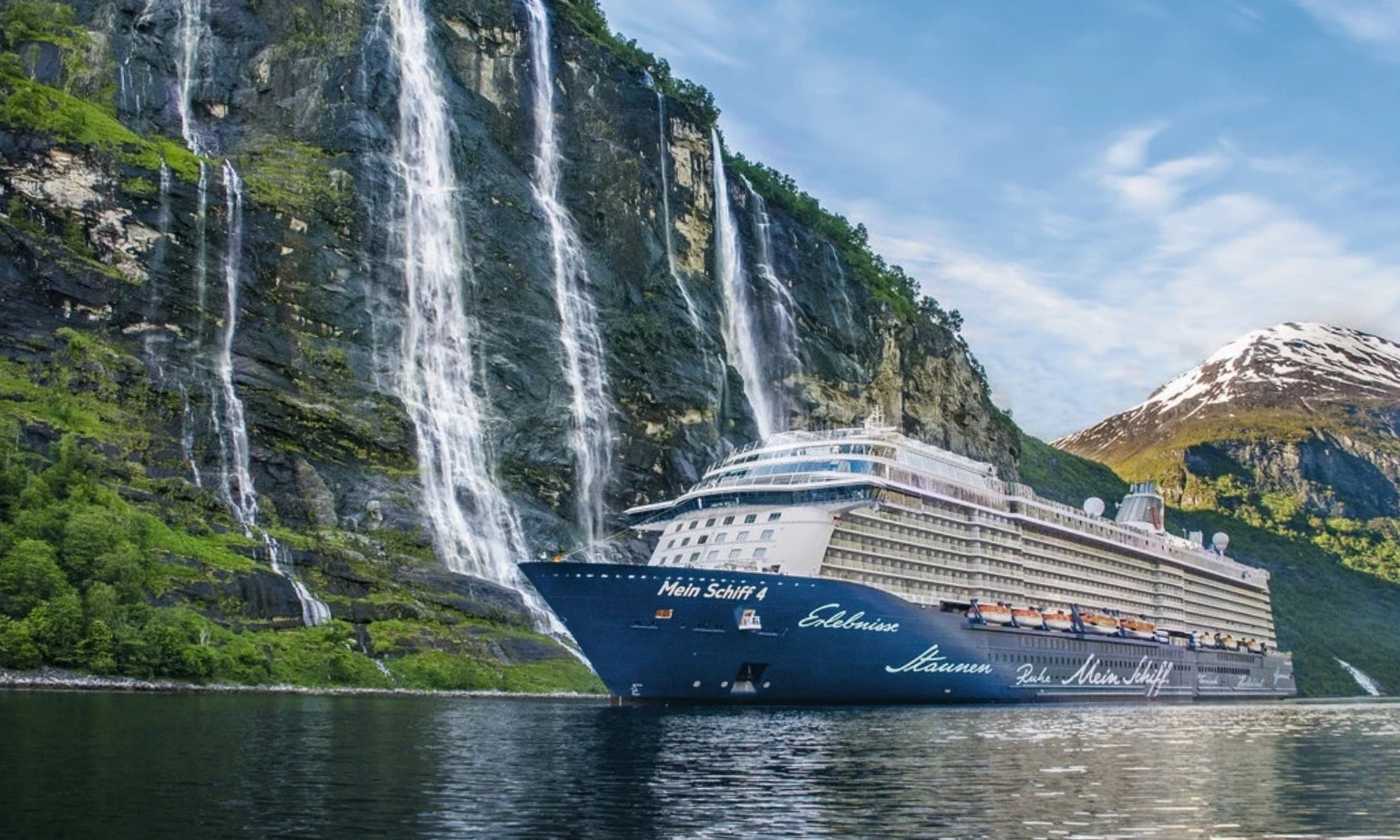
And German ship Mein shiff 4 was stranded in Abu Dhabi when two Iranian missile-armed drones landed and exploded nearby.
According to reports, panic is rising among the 2,500 guests as the 1,000 crew implements safety measures. The ships has been in Abu Dhabi since February 28.
While not many major cruise lines homeport out of the Middle East, many more visit the Middle East on world cruises and other longer itineraries, meaning that if the conflict continues, we’ll likely see many itineraries changed over the coming months.
Flight cancellations and airport closures
Several countries across the Middle East have been forced to close their airspace. According to FlightRadar24, more than 3400 flights were cancelled up until March 1, across seven airports.
The highest profile closure has been that of Dubai airport, which is one of the busiest in the world. At the time of publication, airspace and airports are closed across Israel, Qatar, Syria, Iran, Iray, Kuwait, Bahrain, Oman and the United Arab Emirates.
Cancellations spread across to other international airports that link with the Middle East, such as London Mumbai, Bangkok, Istanbul and more.
Eric Schouten, head of aviation security advisory Dyami, told Reuters that he expects airspace to remain closed.
“Passengers and airlines can expect airspace to be shut for quite some time.”
There is no official word on when airspaces will re-open. Without an agreed ceasefire, it’s likely that airlines will take extreme caution in returning to their normal schedule.
For now, lines such as British Airways have confirmed flights to at risk destinations will be cancelled until at least Wednesday.
Qatar Airways said: “Qatar Airways flight operations remain temporarily suspended due to the closure of Qatari airspace. Qatar Airways will resume operations once the Qatar Civil Aviation Authority announces the safe reopening of Qatari airspace. A further update will be provided on 02 March.”
Airline are likely to continue updating their status daily, but for now, Trump has stated that combat operations will continue, and it appears unlikely that most airlines that fly in the Middle East could resume operations until missile strikes cease completely.
What to know about insurance and war
While some travel insurers do offer coverage for acts of war in certain comprehensive insurance packages, the vast majority do not, and if your travel has been interrupted by the outbreak of this conflict, it’s unlikely that your insurance will cover it.
This generally falls under the “force majeure” exclusions in insurance policies. These generally extend across natural disasters, extreme weather conditions, acts of war and so on
As an example, if you read the terms of Cover-More’s coverage, they explicitly state: “claims arising as a result of war, invasion, act of foreign enemy, hostilities (whether war be declared or not), civil war, rebellion, revolution, insurrection or military or usurped power” will be excluded. Travellers affected by these situations can try and recover costs directly from hotels, tour operators, airlines, cruise lines or whoever else they have paid money to.
If a cruise or flight is cancelled, then you will be owed a refund.

Related Posts
-

A Cruise Passenger poll has revealed that 73% of cruisers won't travel to the USA under Trump.
-
Whether you are a newly retired corporate chief or a digital nomad with plans to work remotely from your ship, going on a world cruise is a life-changing adventure.
-
With Cyclone Alfred already triggering power outages and evacuations along the East Coast, the Cyclone has thrown the cruise industry into disarray. From passengers stuck on shore wondering if their…
-
APT Travel Group founder, Geoff McGeary has passed away peacefully on 18 June, one week before his 84th birthday.