- Australian start-up’s invention could save cruise lines millions while slashing emissions.
- It uses UNSW breakthrough tech and $2,000 tech device made in Redfern.
- Aurora is also banning salmon until the industry “cleans up its act”.
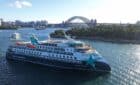
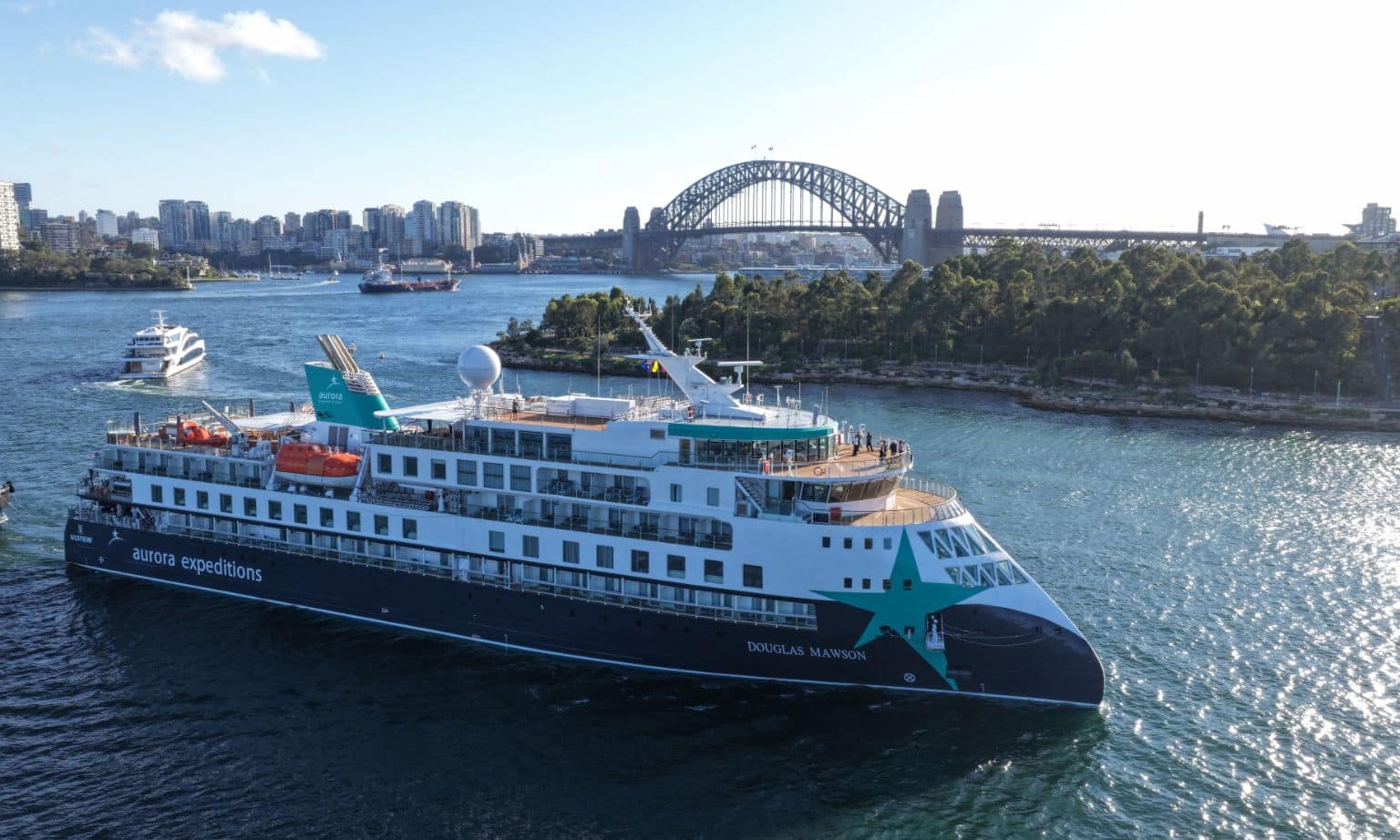
A pioneering Australian invention promising to transform global shipping efficiency has taken its maiden voyage aboard Aurora Expeditions’ newest vessel, the Douglas Mawson.
The innovation – developed by Sydney start-up CounterCurrent – uses artificial intelligence, satellite data and dual-sensor weather stations to map dynamic ocean currents and suggest real-time course adjustments.
Early modelling suggests the system can save up to 5% of fuel on long routes, potentially cutting millions in costs for commercial fleets and reducing emissions across one of the world’s hardest-to-decarbonise industries.
It’s one of a string of new sustainability policies from the line – including banning salmon from menus in protest at the way the salmon industry operates.
The new tech is described by its creators as “Google Maps for the sea”, and is being trialled globally for the first time on the Douglas Mawson, which is sailing from Sydney to Tasmania on its inaugural passenger voyage.
The pilot marks a milestone not only for Australian innovation, but also for Aurora Expeditions, the Australian-owned expedition line long recognised as a leader in sustainable travel.
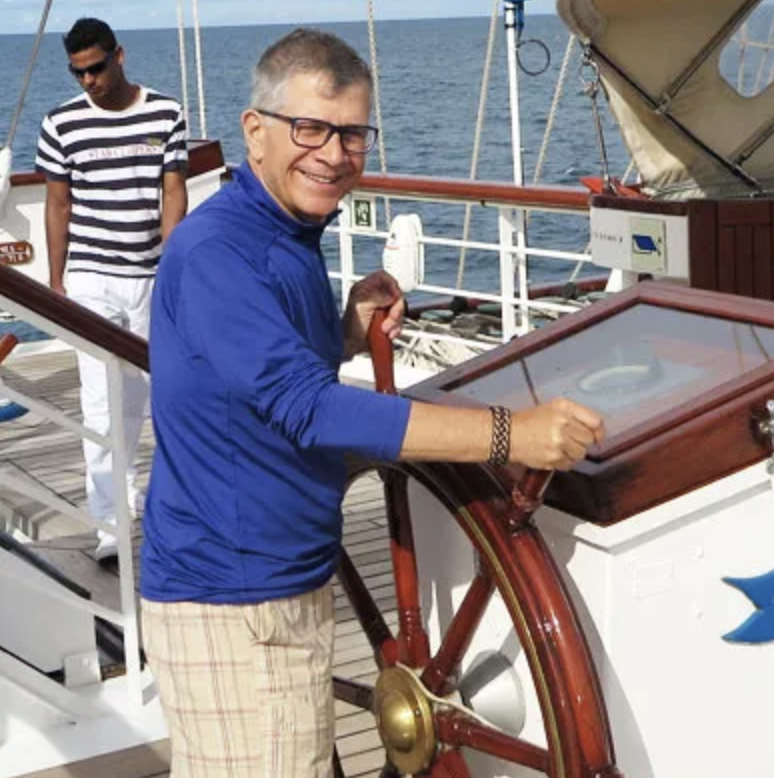
Cruise Passenger publisher Peter Lynch is on board reporting on the maiden sailing. Line founder and Australian adventurer Greg Mortimer, who established Aurora 35 years ago with a mission to take travellers to the world’s wildest places while protecting the environments they visit, is also on board.

AI reads the sea like Google Maps
CounterCurrent’s technical lead Tom McMenamin, who installed the Douglas Mawson’s prototype sensors earlier this week in Sydney, introduced the innovation to guests on board.
Shipping routes today, he explained, generally follow traditional point-to-point or great-circle navigation. But ocean currents do not flow in straight lines—and with newly available high-resolution satellite data, scientists can map their swirling, shifting movements with unprecedented accuracy.
“These services exist in aviation. They exist for cars. But at sea, nothing like this has been available—until now,” McMenamin told passengers.
“We forecast ocean conditions, then create a constantly updating ‘digital twin’ of the ship and its route. Our system suggests optimal pathways that work with the water, not against it.”
Instead of major re-routes, the tech makes subtle, lane-width adjustments within safe navigation corridors – small shifts that add up to significant savings. AI simulations consider thousands of possible weather and current scenarios, delivering only the most reliable and beneficial recommendations to the bridge.
McMenamin likened the process to “Doctor Strange looking at millions of timelines and picking the one where the ship saves the most fuel.”
The system is deliberately “hands-off” and never overrides crew decisions. Instead, it provides intuitive, backed-by-data suggestions that captains can incorporate while maintaining full navigational control.
Crucially, the sensors operate entirely independently of the ship’s systems—solar-powered, satellite-connected and non-intrusive—making them feasible for retrofitting across global fleets.
Aurora Expeditions raises the bar on sustainability
For Aurora, the trial is the latest step in a sweeping sustainability strategy led by Sasha Buch, the company’s Sustainability Manager. Buch says AI-assisted routing could become a powerful tool in Aurora’s broader decarbonisation roadmap.
“Fuel consumption is our largest emissions source,” she explained in her onboard presentation. “This vessel is already highly efficient, but we’re committed to pushing boundaries and trialling innovations no one has used before.”
Buch outlined a suite of initiatives underway across the fleet:
• Salmon ban to bring producers to the table
The line has removed salmon from menus due to the industry’s envirnmental impacts on Tasmania, Chile and Norway. Buch said it would not come back until the industry cleans up its act. Aurora prioritises small-scale, responsible producers, avoiding top predators such as tuna and swordfish.
• Breakthrough biofuel testing
Earlier this year, the Sylvia Earle trialled hydrotreated vegetable oil (HVO)—a renewable fuel derived from waste cooking oil—off the Spanish coast. The result: a 90% reduction in fuel-related emissions. Aurora plans to repeat the trial in 2025 and advocate for wider industry adoption.
• Eliminating microplastic pollution
Up to 35% of ocean microplastics come from clothing fibres—an issue exacerbated by onboard laundry systems. Aurora has partnered with UK innovators Cleanas, installing industrial-scale filters that capture up to 99% of microfibres before wastewater is discharged. The Douglas Mawson is the first ship to trial the technology, with fleetwide rollout planned for next year.
Aurora is also partnering with universities to study microplastic presence in oceans they sail, using filter results to understand what would otherwise have entered the sea.
• Ocean regeneration projects
For every guest on board, Aurora funds the planting of one unit of marine life—seagrass, kelp or coral—and the removal of one kilogram of coastal waste. Projects span Canada, Portugal, Indonesia, Costa Rica and Spain.
• Reducing chemical pollution
New expedition parkas from XTM use recycled plastic, are PFA-free, and arrive in recycled packaging—addressing another widespread pollutant found as far as Antarctica.
Australian collaboration with global potential
The CounterCurrent pilot aligns strongly with Aurora’s B-Corp principles—a certification that requires transparency, continuous improvement and measurable climate action.
“We won’t achieve change alone,” Buch said. “By trialling new technologies, sharing results and inspiring other operators, we hope to move the entire expedition and maritime sectors forward.”
McMenamin agrees. The ocean-current data gathered on this voyage will feed forecasts not just for Aurora ships, but for vessels worldwide.
“The Southern Ocean is one of the most dynamic on Earth,” he said. “Mapping it in real time helps everyone—from cargo ships to scientific vessels—sail more efficiently.”
As the Douglas Mawson charts its inaugural course to Antarctica next week, it is carrying the promise of a cleaner maritime future.
For more, go here.

Related Posts
-

Aurora Expeditions has unveiled 21 amazing voyages across 22 countries for 2027.
-
This morning, the brand-new Aurora Expeditions ship, Douglas Mawson, made her Australian debut in Sydney Harbour.
-
Aurora Expeditions made maritime history on Sydney Harbour as it unveiled its newest ship, the Douglas Mawson, in a ceremony as unconventional and proudly Australian as the company behind it.
-
Once-in-a-lifetime wilderness experiences with Quark Expeditions’ polar-obsessed team are unrivalled: from helicopter rides to humpback whale spotting.